Weekly Narrative Radar · W43 · 19–23 Oct 2026
Where the money went, and what changed in AI
What I'd change my mind on
- Frontier labs going public (N1, 8.6/10). If Anthropic's public S-1 isn't on EDGAR by 6 Nov, or the roadshow doesn't start the week of 9 Nov, I'd downgrade this narrative.
- Robot hands (N3, 7.4/10). If there's no disclosed production deployment, and no intervention or uptime data, by end of Q1 2027, I'd call this capital running ahead of adoption and cut it.
- Models going cross-cloud (N6, 7.0/10). If general availability of OpenAI models on Google Cloud slips past 31 Dec 2026, I'd mark the unbundling story as stalled.
Part 1 · Narratives
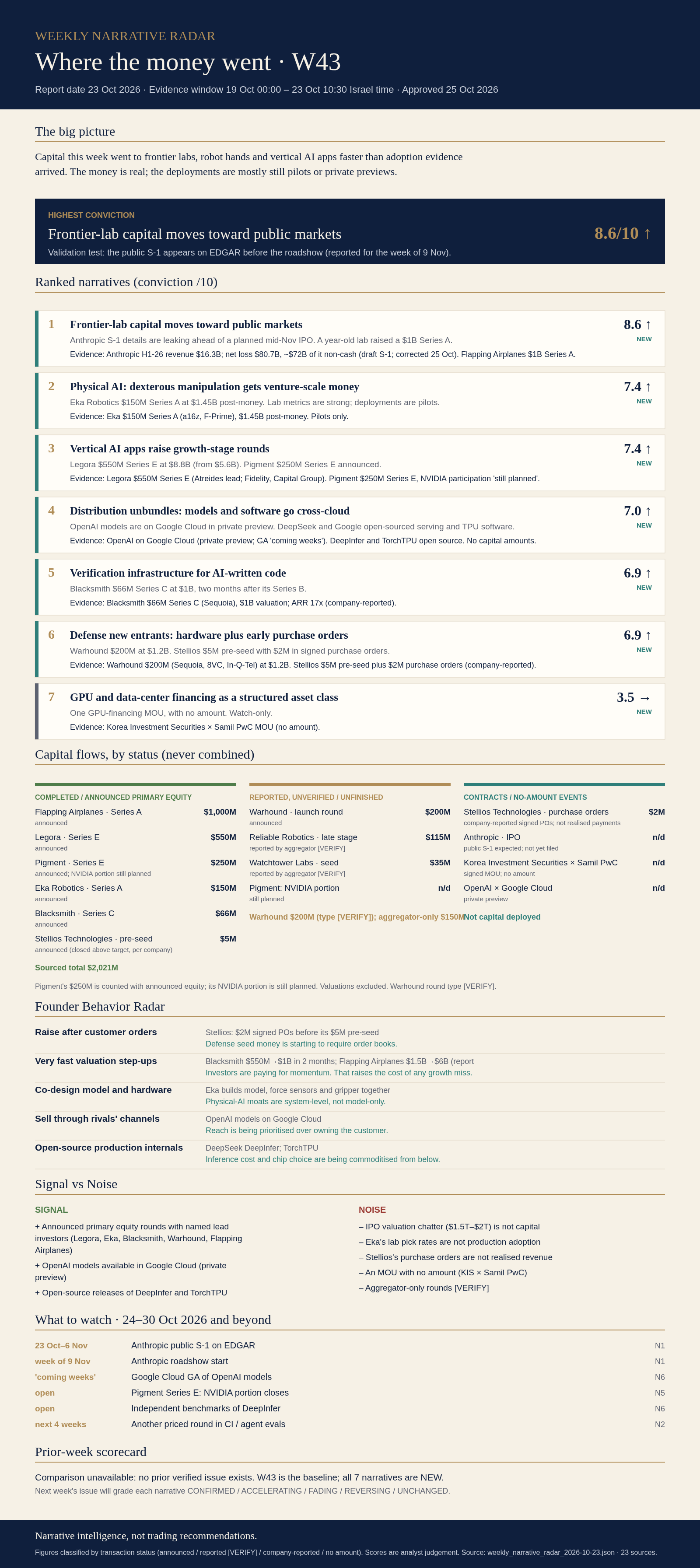
Infographic: PNG (full resolution) · SVG · PDF · dataset JSON · quality gate
Approved by the editor, 25 Oct 2026. Report date 2026-10-23. Evidence window: Mon 19 Oct 2026 00:00 to Fri 23 Oct 2026 10:30, Israel time (Asia/Jerusalem). Narrative intelligence, not trading recommendations.
Thesis. Capital this week went to frontier labs, robot hands and vertical AI apps faster than adoption evidence arrived. The money is real; the deployments are mostly still pilots or private previews.
S1. TL;DR
- Single most important change: Frontier-lab funding is shifting from private mega-rounds to public-market disclosure, led by Anthropic's IPO process.
- Three most consequential narratives: Frontier-lab capital moves toward public markets (8.6/10 ↑); Physical AI: dexterous manipulation gets venture-scale money (7.4/10 ↑); Vertical AI apps raise growth-stage rounds (7.4/10 ↑).
- Highest-conviction positive: Frontier-lab capital moves toward public markets (8.6/10).
- Most consequential negative: a gap between capital and adoption. Physical AI: dexterous manipulation gets venture-scale money has capital 4/5 but adoption 2/5; the money is ahead of deployments.
- Where capital concentrates: frontier labs and vertical AI apps. $2,021M in announced primary equity across 6 sourced rounds, of which Flapping Airplanes ($1,000M) and Legora ($550M) are 77%. Warhound ($200M, round type [VERIFY]) is counted separately.
- Most important question for next week: does Anthropic's public S-1 appear, and do its numbers match the WSJ-reported draft?
S2. Ranked narratives
| Rank | Narrative | Score/10 | Direction | Capital evidence | Conviction |
|---|---|---|---|---|---|
| 1 | Frontier-lab capital moves toward public markets | 8.6 | ↑ NEW | Draft S-1 figures (reported); $1B Series A | High |
| 2 | Physical AI: dexterous manipulation gets venture-scale money | 7.4 | ↑ NEW | $150M Series A, announced | Medium |
| 3 | Vertical AI apps raise growth-stage rounds | 7.4 | ↑ NEW | $550M + $250M Series E, announced | Medium |
| 4 | Distribution unbundles: models and software go cross-cloud | 7.0 | ↑ NEW | No amounts | Medium |
| 5 | Verification infrastructure for AI-written code | 6.9 | ↑ NEW | $66M Series C, announced | Medium |
| 6 | Defense new entrants: hardware plus early purchase orders | 6.9 | ↑ NEW | $200M + $5M rounds; $2M POs (co.-reported) | Medium |
| 7 | GPU and data-center financing as a structured asset class | 3.5 | → NEW | MOU, no amount | Low |
| Scores are analyst-rated factors (0–5 each), weighted capital 25 / adoption 25 / founder 20 / corroboration 20 / attention 10, scaled to 10. They are not measured data. No prior scores exist, so there are no score changes to explain. | |||||
| ### S3. Deep analysis | |||||
| ### 1. Frontier-lab capital moves toward public markets: 8.6/10 ↑ (NEW) | |||||
| Core claim. Frontier-lab funding is shifting from private mega-rounds to public-market disclosure, led by Anthropic's IPO process. | |||||
| Why it matters. The S-1 will be the first audited benchmark of frontier-lab economics. Its loss and compute numbers become the reference point for valuing every lab. | |||||
| Evidence and capital flows. | |||||
| - WSJ (20 Oct) reports a draft Anthropic S-1 showing an $80.7B net loss for H1 2026 and possible spending of $750B on compute, including deals still under negotiation [WSJ]. About $72B of that loss is a non-cash accounting charge for the higher fair value of convertible notes, not cash costs of running the business [RTRL]. (Corrected 25 Oct: added the non-cash context.) | |||||
| - Yahoo Finance (21 Oct), citing WSJ: H1 2026 revenue was $16.3B. Three sources say the public S-1 could be filed as soon as Fri 23 Oct [YF]. | |||||
| - Reuters (22 Oct): the IPO is planned for mid-November, with marketing expected the week of 9 Nov; dates are subject to change [RTR]. | |||||
| - TechCrunch (21 Oct): Flapping Airplanes raised a $1B Series A co-led by Index and Lux, reportedly at a $6B valuation, nine months after a $180M seed [FA]. | |||||
| Founder and company behavior. Labs are choosing public disclosure (Anthropic) and very large early rounds (Flapping Airplanes) over staged private funding. | |||||
| Evidence vs hype. Verified: the draft S-1 figures as reported by WSJ, and the Flapping Airplanes round. Unproven: IPO timing, and any valuation; Reuters cites investor views of $1.5T, Yahoo cites expectations of $2T. Those are speculation, not capital. | |||||
| Invalidation. The public S-1 is not on EDGAR by 6 Nov, or the roadshow does not start the week of 9 Nov. | |||||
| Monitor next week. EDGAR public S-1 (expected 23 Oct–early Nov); roadshow week of 9 Nov. | |||||
| Verdict. The most consequential capital story of the week. Its direction depends on the S-1 actually appearing. | |||||
| Factors: capital 5, adoption 3, founder 4, corroboration 5, attention 5 (each 0–5). | |||||
| ### 2. Physical AI: dexterous manipulation gets venture-scale money: 7.4/10 ↑ (NEW) | |||||
| Core claim. Venture capital is pricing robot manipulation like a foundation-model bet before production deployments exist. | |||||
| Why it matters. If dexterous manipulation works in production, automation extends into unstructured physical work, which is a much larger market than today's fixtured robotics. | |||||
| Evidence and capital flows. | |||||
| - Eka Robotics raised a $150M Series A at $1.45B post-money, led by a16z and F-Prime (20 Oct) [EKA][EKATC][A16Z]. | |||||
| - Company-reported lab figures: up to 1,500 picks per hour, versus about 600 for a human; >95% pick reliability per TechCrunch [EKA][EKATC]. a16z: sustaining that through full production shifts 'is the next test' [A16Z]. | |||||
| - Just Raised reports a $115M late-stage round for Reliable Robotics (autonomous flight) on 20 Oct [VERIFY: single aggregator] [JR]. | |||||
| Founder and company behavior. Founders from academia and DeepMind are building model, sensors and hardware together, and training in simulation instead of on human demonstrations. | |||||
| Evidence vs hype. Verified: the round. Company-reported and not independently verified: pick rates. Unproven: production reliability; the gripper is at 5M of a 20M duty-cycle industrial benchmark (per SiliconReport, not cited as a primary source). | |||||
| Invalidation. No disclosed production deployment, or no intervention or uptime data, by end of Q1 2027. | |||||
| Monitor next week. Eka customer deployment announcements. | |||||
| Verdict. Strong capital, weak adoption. Track it, but don't treat the round as demand. | |||||
| Factors: capital 4, adoption 2, founder 4, corroboration 5, attention 4 (each 0–5). | |||||
| ### 3. Vertical AI apps raise growth-stage rounds: 7.4/10 ↑ (NEW) | |||||
| Core claim. Crossover and mutual-fund investors are writing late-stage cheques into vertical AI applications. | |||||
| Why it matters. Late-stage money signals that investors believe vertical AI can hold pricing against the model labs. | |||||
| Evidence and capital flows. | |||||
| - Legora (legal AI) raised a $550M Series E at $8.8B post-money, up from $5.6B, led by Atreides with Fidelity and Capital Group among new investors (21 Oct) [LEG][LEGTC][SEU]. | |||||
| - Pigment announced a $250M Series E; NVIDIA participation is described as still planned (21 Oct) [FDR][CUT]. | |||||
| Founder and company behavior. Vertical app companies are raising growth rounds to expand geographically (Legora: North America) and to build agent layers. | |||||
| Evidence vs hype. Verified: the Legora round (company release plus press). Partly unfinished: Pigment, since the NVIDIA portion isn't closed. No revenue figures were sourced this week, so adoption is inferred, not shown. | |||||
| Invalidation. Flat or down rounds in legal or planning AI within 6 months. | |||||
| Monitor next week. Pigment round completion (NVIDIA portion). | |||||
| Verdict. Real capital, credible investors. Adoption still needs revenue evidence. | |||||
| Factors: capital 5, adoption 3, founder 3, corroboration 4, attention 3 (each 0–5). | |||||
| ### 4. Distribution unbundles: models and software go cross-cloud: 7.0/10 ↑ (NEW) | |||||
| Core claim. Frontier models and serving software are no longer tied to one cloud or one chip. | |||||
| Why it matters. Enterprise procurement moves to cloud contracts, and switching costs between accelerators fall. | |||||
| Evidence and capital flows. | |||||
| - OpenAI models are in private preview in Google Cloud's Model Garden, payable from existing cloud commitments; GA is planned 'in the coming weeks' (21 Oct) [OAI][GC]. | |||||
| - DeepSeek open-sourced DeepInfer, its serving engine, for Nvidia SM100 and Huawei Ascend 950 (20 Oct) [DI]. | |||||
| - TorchTPU released open source, giving native PyTorch support on TPUs (20 Oct) [TT]. | |||||
| Founder and company behavior. Labs are choosing reach through hyperscaler marketplaces over owning the customer relationship. | |||||
| Evidence vs hype. Verified: the announcements. Unproven: uptake. It's a private preview, and DeepInfer's speed figures are DeepSeek's own. | |||||
| Invalidation. Google Cloud GA slips beyond 31 Dec 2026. | |||||
| Monitor next week. Google Cloud GA date for OpenAI models. | |||||
| Verdict. Structural, but this week's evidence is about access, not adoption. | |||||
| Factors: capital 2, adoption 4, founder 3, corroboration 5, attention 4 (each 0–5). | |||||
| ### 5. Verification infrastructure for AI-written code: 6.9/10 ↑ (NEW) | |||||
| Core claim. As agents write more code, money and founders are moving to testing and verifying it. | |||||
| Why it matters. The bottleneck in agent coding moves from writing code to trusting it. | |||||
| Evidence and capital flows. | |||||
| - Blacksmith (CI and testing) raised a $66M Series C led by Sequoia at a $1B valuation, two months after a Series B at $550M (21 Oct) [BS]. | |||||
| - Company-reported: ARR grew 17x and it has run over 90M CI jobs. Customers include Mercury and Granola [BS]. | |||||
| - OpenAI's Codex agent workflows are being distributed through Google Cloud [OAI][GC]. | |||||
| Founder and company behavior. Founders are positioning CI as the 'trust layer' for agent code. Valuation step-ups are compressed into months. | |||||
| Evidence vs hype. Verified: the round, though only one outlet was checked. Company-reported: the ARR multiple and job count. That Codex demand drives CI volume is an interpretation. | |||||
| Invalidation. No other CI, code-review or agent-eval startup raises a priced round in the next 4 weeks. | |||||
| Monitor next week. Rounds in CI, code review and agent evals. | |||||
| Verdict. Early but coherent. Needs a second company to confirm the pattern. | |||||
| Factors: capital 3, adoption 4, founder 4, corroboration 3, attention 3 (each 0–5). | |||||
| ### 6. Defense new entrants: hardware plus early purchase orders: 6.9/10 ↑ (NEW) | |||||
| Core claim. New defense startups lead with hardware and, in some cases, customer orders before they raise. | |||||
| Why it matters. Order books, not demos, are becoming the bar for defense seed money. | |||||
| Evidence and capital flows. | |||||
| - Warhound came out of stealth with $200M at a $1.2B valuation from investors including Sequoia, 8VC and In-Q-Tel (22 Oct) [WH]. | |||||
| - Stellios Technologies (high-power microwave counter-drone) raised a $5M pre-seed and reports $2M in signed purchase orders (announced 20 Oct) [STL]. | |||||
| - Just Raised counts 7 defence and dual-use rounds in the week of 19 Oct, and 22 hardware versus 11 software rounds over 26 weeks [JR]. | |||||
| Founder and company behavior. Founders secure purchase orders before raising (Stellios). Strategic and intelligence-linked investors (In-Q-Tel) appear at launch. | |||||
| Evidence vs hype. Verified: the rounds. Company-reported: the purchase orders, and they are not realised payments. Unproven: Warhound's product, since its dogs 'do not exist yet' per TechCrunch. Just Raised's Castelion date was wrong (see rejected evidence), which lowers trust in that aggregator. | |||||
| Invalidation. The purchase orders aren't converted to deliveries, or the round count drops back to the 26-week average. | |||||
| Monitor next week. Counter-UAS contract awards. | |||||
| Verdict. Capital is clear. Commercial evidence is thin and company-reported. | |||||
| Factors: capital 4, adoption 3, founder 4, corroboration 3, attention 3 (each 0–5). | |||||
| ### 7. GPU and data-center financing as a structured asset class: 3.5/10 → (NEW) | |||||
| Core claim. Banks are starting to package GPUs and data centers as financeable assets. | |||||
| Why it matters. If GPUs become standard collateral, compute capacity can grow faster than equity alone allows. | |||||
| Evidence and capital flows. | |||||
| - Korea Investment Securities signed a GPU-financing MOU with Samil PwC on 20 Oct; no amounts were disclosed [KIS]. | |||||
| - Anthropic's draft S-1 points to possible spending of $750B on compute, including deals still under negotiation [WSJ]. | |||||
| Founder and company behavior. No founder behavior evidenced this week. | |||||
| Evidence vs hype. An MOU is not capital deployed. The $750B is a possible future spend, not a commitment. | |||||
| Invalidation. No priced GPU-backed debt deal in the next 4 weeks. | |||||
| Monitor next week. Priced GPU ABS or project-finance deals. | |||||
| Verdict. Thin. Kept as watch-only. | |||||
| Factors: capital 2, adoption 1, founder 2, corroboration 2, attention 2 (each 0–5). | |||||
| ### S4. Capital Flow Ledger | |||||
| Company / transaction | Amount (US$M) | Type | Status | Source | |
| --- | --- | --- | --- | --- | |
| Flapping Airplanes · Series A | 1,000 | primary equity | announced | FA | |
| Legora · Series E | 550 | primary equity | announced | LEG | |
| Pigment · Series E | 250 | primary equity | announced; NVIDIA portion still planned | FDR | |
| Warhound · launch round | 200 | primary equity [VERIFY type] | announced | WH | |
| Eka Robotics · Series A | 150 | primary equity | announced | EKA | |
| Blacksmith · Series C | 66 | primary equity | announced | BS | |
| Stellios Technologies · pre-seed | 5 | primary equity | announced (closed above target, per company) | STL | |
| Reliable Robotics · late stage | 115 | primary equity | reported by aggregator [VERIFY] | JR | |
| Watchtower Labs · seed | 35 | primary equity | reported by aggregator [VERIFY] | JR | |
| Stellios Technologies · purchase orders | 2 | commercial contract | company-reported signed POs; not realised payments | STL | |
| Anthropic · IPO | n/d | IPO process | public S-1 expected; not yet filed | RTR | |
| Korea Investment Securities × Samil PwC | n/d | financing MOU | signed MOU; no amount | KIS | |
| OpenAI × Google Cloud | n/d | distribution partnership | private preview | OAI | |
| Totals (comparable, non-overlapping categories only): announced primary equity, sourced: $2,021M (6 rounds). Warhound $200M, counted separately because its round type is [VERIFY]. Aggregator-only primary equity [VERIFY]: $150M (2 rounds). Company-reported commercial contracts: $2M. There is no blended total. Valuations, the IPO, the MOU and the partnership carry no amounts. | |||||
| ### S5. Founder Behavior Radar | |||||
| Behavior | Evidence | Strategic interpretation | |||
| --- | --- | --- | |||
| Raise after customer orders | Stellios: $2M signed POs before its $5M pre-seed [STL] | Defense seed money is starting to require order books. | |||
| Very fast valuation step-ups | Blacksmith $550M→$1B in 2 months [BS]; Flapping Airplanes $1.5B→$6B (reported) in 9 months [FA] | Investors are paying for momentum. That raises the cost of any growth miss. | |||
| Co-design model and hardware | Eka builds model, force sensors and gripper together [A16Z] | Physical-AI moats are system-level, not model-only. | |||
| Sell through rivals' channels | OpenAI models on Google Cloud [OAI] | Reach is being prioritised over owning the customer. | |||
| Open-source production internals | DeepSeek DeepInfer [DI]; TorchTPU [TT] | Inference cost and chip choice are being commoditised from below. | |||
| No sourced evidence of pivots, layoffs or abandonment this week [gap]. | |||||
| ### S6. Signal vs Noise | |||||
| SIGNAL | |||||
| - Announced primary equity rounds with named lead investors (Legora, Eka, Blacksmith, Warhound, Flapping Airplanes) | |||||
| - OpenAI models available in Google Cloud (private preview) | |||||
| - Open-source releases of DeepInfer and TorchTPU | |||||
| NOISE | |||||
| - IPO valuation chatter ($1.5T–$2T) is not capital | |||||
| - Eka's lab pick rates are not production adoption | |||||
| - Stellios's purchase orders are not realised revenue | |||||
| - An MOU with no amount (KIS × Samil PwC) | |||||
| - Aggregator-only rounds [VERIFY] | |||||
| ### S7. Prior-week scorecard | |||||
| Previous narrative | Prior assessment | Current assessment | Evidence of change | ||
| --- | --- | --- | --- | ||
| (none) | Comparison unavailable | — | — | ||
| Comparison unavailable: no prior verified Weekly Narrative Radar exists. W43 is the baseline. All narratives are classed NEW; no historical scores or predictions are invented. | |||||
| ### S8. Highest-conviction narrative | |||||
| Frontier-lab capital moves toward public markets (8.6/10 ↑). It ranks first because it is the only narrative with high marks on both capital (5/5) and corroboration (5/5): WSJ, Yahoo Finance and Reuters independently report the S-1 process, and a second, separate lab raised $1B the same week. Capital and founder behavior align in that labs are choosing disclosure and very large early rounds. Principal uncertainty: the figures come from a draft prospectus reported by the press, not the public filing. Single most important validation test: the public S-1 appears on EDGAR before the roadshow (reported for the week of 9 Nov). | |||||
| ### S9. What to watch next week (24–30 Oct 2026 and beyond) | |||||
| Priority | Dates | Item | Narrative | ||
| --- | --- | --- | --- | ||
| 1 | 23 Oct–6 Nov | Anthropic public S-1 on EDGAR | N1 | ||
| 2 | week of 9 Nov | Anthropic roadshow start | N1 | ||
| 3 | 'coming weeks' | Google Cloud GA of OpenAI models | N6 | ||
| 4 | open | Pigment Series E: NVIDIA portion closes | N5 | ||
| 5 | open | Independent benchmarks of DeepInfer | N6 | ||
| 6 | next 4 weeks | Another priced round in CI / agent evals | N2 | ||
| ### S10. Market context (separate; no trading signals) | |||||
| - Reuters (22 Oct): the fall tech-IPO calendar is 'down to just Anthropic' amid AI market jitters [RTR]. | |||||
| - Yahoo Finance (21 Oct): investors are more concerned about the AI industry's massive spending [YF]. | |||||
| - Not researched this week [unavailable]: financing costs, credit spreads, public versus private valuation gaps. | |||||
| This section is context only. It contains no buy or sell views, prices, sizing or market-permission calls, and no OSINT. | |||||
| ### Rejected evidence | |||||
| - Castelion $1B round: Just Raised lists it as announced 19 Oct, but the company release is dated 19 Aug 2026, outside the window. Excluded. CAS | |||||
| ### Sources | |||||
| - [A16Z] Andreessen Horowitz, Investing in Eka Robotics (2026-10-20). https://a16z.com/announcement/investing-in-eka-robotics/ | |||||
| - [BS] TechCrunch, Blacksmith hits unicorn valuation after Sequoia leads Series C (2026-10-21). https://techcrunch.com/2026/10/21/blacksmith-hits-unicorn-valuation-after-sequoia-leads-series-c/ | |||||
| - [CAS] Castelion, Castelion Raises $1B Series C (2026-08-19). https://www.castelion.com/news/series-c/ | |||||
| - [CUT] Cutoff Report, Startup & AI funding today, 21 October 2026 (2026-10-21). https://cutoffreport.com/posts/ai-startup-funding-roundup-2026-10-21 | |||||
| - [DI] The Next Web, DeepSeek open-sources DeepInfer (2026-10-20). https://thenextweb.com/news/deepseek-deepinfer-open-source-inference-engine | |||||
| - [EKA] Eka Robotics, Eka Robotics Raises $150M (2026-10-20). https://ekarobotics.com/blog/eka-robotics-raises-150m-to-build-superhuman-intelligence-for-the-physical-world | |||||
| - [EKATC] TechCrunch, Eka is worth $1.45B thanks to a physical AI model (2026-10-20). https://techcrunch.com/2026/10/20/eka-is-worth-1-45-billion-thanks-to-a-physical-ai-model-that-has-experts-raving/ | |||||
| - [FA] TechCrunch, Year-old AI lab Flapping Airplanes raises $1B at a $6B valuation (2026-10-21). https://techcrunch.com/2026/10/21/year-old-ai-lab-flapping-airplanes-raises-1b-at-a-6b-valuation/ | |||||
| - [FDR] Foundra, The Daily Brief, 21 Oct 2026 (2026-10-21). https://foundranews.com/edition?date=2026-10-21 | |||||
| - [GC] Google Cloud Blog, Google Cloud brings OpenAI models to customers (2026-10-21). https://cloud.google.com/blog/products/ai-machine-learning/google-cloud-brings-openai-models-to-customers | |||||
| - [JR] Just Raised, Defence rounds: hardware still dominates software (2026-10-22). https://justraised.io/blog/jpmorgan-s-1b-castelion-bet-brings-banks-into | |||||
| - [KIS] DigitalToday, Korea Investment Securities teams up with Samil PwC on GPU financing (2026-10-21). https://www.digitaltoday.co.kr/en/view/117405/korea-investment-securities-expand-ai-infrastructure-finance-join-hands-with-samil-pwc-on-gpu-financing | |||||
| - [LEG] Legora, Legora raises $550 million Series E at $8.8 billion valuation (2026-10-21). https://legora.com/newsroom/legora-raises-550-million-series-e-at-8.8-billion-valuation-to-accelerate-growth | |||||
| - [LEGTC] TechCrunch, Legal AI startup Legora raises $550M Series E at $8.8B valuation (2026-10-21). https://techcrunch.com/2026/10/21/legal-ai-startup-legora-raises-550m-series-e-at-8-8b-valuation/ | |||||
| - [OAI] OpenAI, OpenAI models are coming to Google Cloud (2026-10-21). https://openai.com/index/openai-models-google-cloud | |||||
| - [RTR] Reuters (via Investing.com), Anthropic IPO stands alone as AI market jitters sideline others (2026-10-22). https://www.investing.com/news/economy-news/analysisanthropic-ipo-stands-alone-as-ai-market-jitters-sideline-others-4966313 | |||||
| - [RTRL] Reuters (via Euronext), Anthropic logged net loss of over $80 billion in first half of 2026 (2026-10-20). https://live.euronext.com/en/financial-news/anthropic-logged-net-loss-over-80-billion-first-half-2026 | |||||
| - [SEU] Startup.eu, Startup funding, 21 October 2026 (2026-10-21). https://www.startup.eu/archive/2026-10-21 | |||||
| - [STL] DroneNR, Stellios Technologies raises $5M for counter-drone microwave weapons (2026-10-22). https://dronenr.com/2026/10/22/stellios-counter-drone-microwave-funding/ | |||||
| - [TT] Google Cloud Blog, TorchTPU is now open source (2026-10-20). https://cloud.google.com/blog/topics/ai-infrastructure/torchtpu-is-now-open-source-run-native-pytorch-on-tpus | |||||
| - [WH] TechCrunch, Warhound raises $200M to engineer war dogs (2026-10-22). https://techcrunch.com/2026/10/22/ben-lamm-raises-200m-for-warhound-to-engineer-war-dogs-and-arm-them-with-anduril-gear/ | |||||
| - [WSJ] WSJ, Anthropic S-1 Shows Red-Hot Growth, Risks and Massive Computing Costs (2026-10-20). https://www.wsj.com/tech/ai/anthropic-revenue-growth-ipo-accaf0f1 | |||||
| - [YF] Yahoo Finance, Anthropic to publicly file for IPO as early as Friday, sources say (2026-10-21). https://finance.yahoo.com/markets/article/anthropic-to-publicly-file-for-ipo-as-early-as-friday-sources-say-135343841.html |
Quality gate: PASS WITH FLAGS (12/12 checks run, 0 failed). Flags: Prior-week scorecard empty: this is the baseline issue. Single-source items: Blacksmith (TechCrunch only, ARR company-reported); Reliable Robotics and Watchtower via Just Raised [VERIFY]. Warhound round type not stated by the source [VERIFY]. Factor ratings are analyst judgement. Market context: financing costs and credit not researched [unavailable]. PDF/Canva: PDF produced; no Canva design made.
Part 2 · AI ecosystem signals
Distribution beats exclusivity
Weekly Narrative Radar · AI ecosystem signals · W43 · 19–23 Oct 2026
Thesis. This week the AI stack got less exclusive at almost every software layer. Frontier models went on sale inside a rival's cloud, and the software that serves models and the software that targets TPUs both opened up. Governments moved the other way and hardened the hardware border.
1. OpenAI models go on sale inside Google Cloud
What happened. On 21 October, OpenAI and Google Cloud said OpenAI's frontier models and its Codex agent will be sold through Google Cloud's Model Garden and billed through Google Cloud Marketplace [1][2]. GPT-6 Astra, GPT-6.1 Sol and GPT-6 Luna are rolling out now in private preview to selected enterprise customers. General availability is planned "in the coming weeks" [1][2]. Customers can pay for them out of their existing Google Cloud spend commitments. OpenAI added that Microsoft remains its primary cloud partner [1][3]. Reuters reports that OpenAI's exclusive distribution deal with Microsoft expired in April. Since then OpenAI has added AWS, and now Google [3].
Why it matters. Interpretation: For a large company, the hardest part of buying a model is procurement, not the API. When a model can be paid for from cloud budget that is already committed, the buying decision moves from the AI team to the cloud contract. Labs then compete model against model, inside a storefront that someone else owns. Google is now hosting the products of its most direct consumer competitor. That suggests clouds see neutral distribution as worth more than protecting their own model.
Watch next. The general availability date. Whether the per-token price on Google's marketplace matches OpenAI's own API. Whether other labs' terms on the same marketplaces change in response.
2. DeepSeek open-sources the engine behind its API, and puts Huawei next to Nvidia
What happened. On 20 October, DeepSeek released DeepInfer, its in-house inference framework, under the Apache 2.0 licence. For now it supports only DeepSeek-V4.1-Flash [4][5]. It runs on Nvidia SM100-class GPUs and on Huawei Ascend 950 NPUs [4][5]. The release leaves out three pieces a full service needs: a KV cache system, prefill/decode disaggregation and replica load balancing. Its speed figures are DeepSeek's own and have not been tested independently [4][5]. It arrived a day after the US ordered civilian federal agencies to remove DeepSeek products from their systems [4].
Why it matters. Interpretation: Serving cost is where most of the margin in model APIs is won or lost. Labs usually keep these techniques private. By publishing them, DeepSeek lowers the cost of hosting its models for any cloud provider or enterprise, which helps the models spread just as Washington pushes them out of government use. Giving Huawei silicon equal billing in the code also turns "runs well on Chinese chips" from a claim into something you can check.
Watch next. Independent benchmarks. Whether the missing serving components are released. Whether US restrictions spread from federal systems to contractors.
3. TorchTPU: native PyTorch on Google TPUs goes open source
What happened. On 20 October, Google and the PyTorch project released TorchTPU as open source. It is a native PyTorch backend that makes a Cloud TPU appear as a standard device, with eager mode and torch.compile support [6][7].
Why it matters. Interpretation: Nvidia's moat has always been as much about software as silicon. Most model code is written in PyTorch and assumes CUDA. If PyTorch runs on TPUs with only a device change, the cost of switching accelerators drops for teams that do not want to rewrite their code. This is the developer-stack version of signal 1: Google is taking away the reasons not to run on its cloud.
Watch next. Migration stories from large PyTorch users outside Google. How TPU capacity is priced and how much is available compared with GPUs.
4. Taiwan moves to criminalise illicit AI chip exports to China
What happened. Taiwan's Ministry of Economic Affairs advanced plans on 20 October to make unauthorised exports of advanced AI processors and servers to China a criminal offence under the Foreign Trade Act. Prison terms would run up to five years [8]. Earlier, Taiwan's economy minister told Bloomberg the measures would match US controls under the two governments' reciprocal trade agreement. He gave no start date [9]. Separately, Reuters reported that the US Commerce Department is drafting rules that would tie AI chip export licences to foreign companies' investment in the US. No rule text has been published [10].
Why it matters. Interpretation: Smuggling and transshipment have been the main leak in chip controls. Criminal penalties in the island where the chips are made close the loop in enforcement. Combined with the reported US approach of granting licences in exchange for investment, export policy is turning from a list of banned parts into a tool for steering where supply chains get built.
Watch next. The amendment's text and timing in the Legislative Yuan. Whether the US draft rule appears with a comment period.
5. Anthropic circulates its own federal AI safety bill
What happened. Anthropic has circulated a draft federal AI safety bill among lawmakers. It has not been formally introduced [11][12]. As reported, the draft would let the government move against a model that poses catastrophic risk, defined by thresholds such as 50 or more deaths [11] or $1 billion in damage [12].
Why it matters. Interpretation: A frontier lab writing the rulebook it would itself follow is as much a competitive move as a safety one. Thresholds set this high bind very few developers, and a federal standard could shape or override state rules. Any legislative text supported by a lab sets a baseline the other labs then have to respond to.
Watch next. A sponsor and formal introduction. How OpenAI, Google and Meta respond publicly. How state lawmakers react.
The pattern
Interpretation: Three of the five signals are about removing exclusivity in software and distribution: models on any cloud, serving code anyone can run, PyTorch on any accelerator. The other two concern rules and borders. Value is moving away from owning a single stack and toward control of chokepoints: procurement channels, silicon supply and the regulatory baseline. Forecast (low confidence): Within a year, expect cloud marketplaces rather than labs' own APIs to become the main channel through which enterprises buy frontier models.
Radar
| Signal | Layer | Direction | Confidence |
|---|---|---|---|
| OpenAI on Google Cloud | Apps/distribution | ↑ open | High |
| DeepInfer open-sourced | Compute/infra | ↑ cheaper serving | Medium |
| TorchTPU | Developer stack | ↑ access | High |
| Taiwan chip export crime | Geopolitics/supply chain | ↓ tightening | Medium |
| Anthropic draft bill | Policy/safety/law | ↑ activity | Medium |
Market context, not investment advice. Facts carry sources; interpretation and forecasts are labelled. Corrections are timestamped below.
Corrections:
- 25 Oct 2026, 10:40 (Asia/Jerusalem) · Part 1, narrative N1 (Frontier-lab capital moves toward public markets). Was:
"a draft Anthropic S-1 showing an $80.7B net loss for H1 2026"with no context. Now: the same $80.7B figure, plus "About $72B of that loss is a non-cash accounting charge for the higher fair value of convertible notes, not cash costs of running the business." Source: Reuters, 20 Oct (via Euronext) (T2). Score unchanged at 8.6/10: none of the five scoring inputs (capital, adoption, founder behaviour, corroboration, attention) depends on the size or make-up of the loss.
Signal sources
- OpenAI: OpenAI models are coming to Google Cloud (2026-10-21)
- Google Cloud Blog: Google Cloud brings OpenAI models to customers (2026-10-21)
- Reuters (via Investing.com): OpenAI to sell its top models on Google Cloud in latest enterprise push (2026-10-21)
- The Next Web: DeepSeek open-sources DeepInfer, the engine that runs its AI models (2026-10-20)
- The New Stack: DeepSeek open-sources the inference engine behind its API (2026-10-20)
- Google Cloud Blog: TorchTPU is now open source: Run native PyTorch on TPUs (2026-10-20)
- PyTorch Blog: Introducing TorchTPU (2026-10-20)
- East Asia Brief: Taiwan bans illicit AI chip exports to China under revised trade act (2026-10-21)
- Bloomberg (via Yahoo Finance): Taiwan to Curb AI Chip Exports to China as Part of US Trade Deal (2026-10-16)
- Chip Dispatch (citing Reuters): US Drafts AI Chip Export Rules Tying Licenses to US Investment (2026-10-14)
- TechCrunch: Anthropic pitches AI safety bill that may block a model if 50+ people could be killed (2026-10-20)
- Politico: Why Anthropic's draft bill sets $1 billion threshold for AI risk (2026-10-21)